Frequently Asked Questions
What's the difference between a standby generator and a portable one?
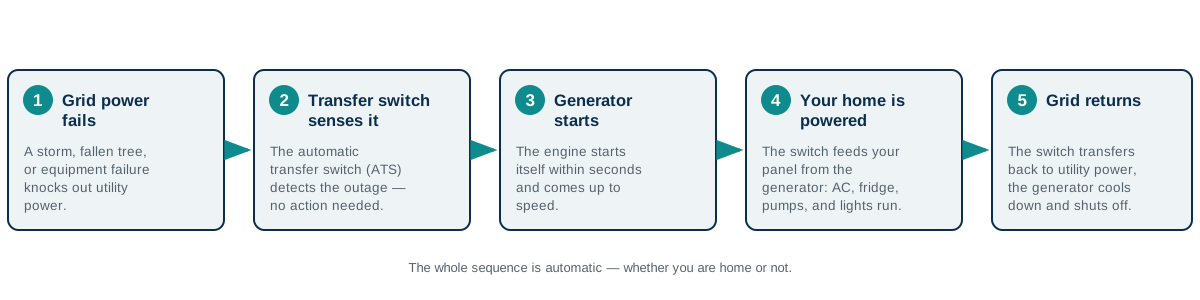
A portable generator lives in your garage, gets rolled out during an outage, and powers a few things through extension cords or a manual inlet — if someone is home to set it up. A standby generator is permanently installed outside like an AC unit, wired to your panel through an automatic transfer switch, and starts itself within seconds of an outage. On the Alabama coast, where outages after a landfalling storm run for days and many homes sit empty, that automatic part is the whole point.
When is the best time to install — before hurricane season?
Yes: aim to be installed before June 1, when Atlantic hurricane season opens (it runs through November 30). The practical reason is the calendar. A normal install — site visit, quote, HOA and permit steps, scheduling — takes a few weeks, and installer schedules are calmest from late fall through early spring. After a storm threatens or hits, every generator dealer on the coast books out for months, and a portable unit in a garage is what you're left with. If you're reading this in April or May, you're not too late — but don't wait for the first named storm.
What size generator does my home need?
Most Baldwin County homes land at 22–26kW for true whole-home coverage with central AC. Smaller homes, or homes willing to manage loads, can use 14–18kW. Two local adjustments matter: inland homes on wells must carry the well pump (and a septic pump, if fitted), and beach houses with pools add the pool pump. An installer calculates size from your panel, AC tonnage, and big loads — be wary of anyone who quotes a size without asking. For a planning estimate, try our generator sizing calculator.
Natural gas or propane — which will my home use?
It depends on your street, and in Baldwin County the map is a patchwork. On the Eastern Shore, Daphne Utilities runs the gas system in Daphne and along the shore, and the City of Fairhope provides gas in Fairhope. In and around Foley, natural gas comes from Riviera Utilities. Many Gulf Shores and Orange Beach neighborhoods have gas, and many don't. Inland — Loxley, Robertsdale, and the county's rural areas — propane with an on-site tank is the default. Neither fuel is "better" in the abstract: natural gas never needs refilling but many units are rated slightly lower on it (a 22kW model may be 19.5kW on natural gas), while propane gives you an on-site fuel reserve sized to your tank. Your installer confirms what's available at your address before quoting.
I own a second home or vacation rental. Can I monitor the generator remotely?
Yes — and in the beach market it's close to a standard feature. Current standby units offer Wi-Fi monitoring (Generac's Mobile Link is the best-known) that reports weekly exercise runs, faults, and every outage start/stop to your phone. For a rental, that answers the questions that matter from three states away: Did the power go out? Is the generator running? Is the house ready for Saturday's check-in? Make sure monitoring hardware and setup appear as a line item on your quote, and that the unit gets a strong Wi-Fi or cellular signal where it sits.
My home is in a flood zone. Does the generator need to be elevated?
Generally, yes. In mapped flood zones (AE and VE zones cover much of Gulf Shores, Orange Beach, and the bay and bayou shorelines), local flood rules typically require permanently installed equipment like generators and transfer switches to sit at or above the required flood elevation for the lot — which is why so many coastal installs sit on a raised platform or stand next to an elevated house. The exact requirement runs through your city's building department and your property's elevation certificate; your installer builds it into the site plan and the quote. Don't accept a coastal quote that says nothing about elevation until you've asked.
Do I need a permit in Daphne, Foley, Gulf Shores, or Orange Beach?
Yes. Every Baldwin County city permits standby generator work — typically a building permit plus trade permits for the electrical and fuel work, with inspections afterward (Orange Beach, for example, permits electrical and gas trade work separately through its online portal). Properties outside city limits permit through Baldwin County. Your installation provider should pull the permits as part of the job — confirm that in writing on the quote. Each city page on this site links to its building department.
Will my HOA allow a generator?
Generally yes, with conditions. Baldwin County HOAs and POAs — Lake Forest in Daphne is the big one, along with communities in Spanish Fort, Foley, and Ono Island in Orange Beach — usually treat a standby generator like other exterior equipment: architectural review, placement rules (side or rear yard, near the AC unit), setbacks, and sometimes screening or limits on weekly exercise times. Your installer will usually prepare the placement drawing the association needs. Starting the approval before your install date avoids the classic problem: a permitted generator that the HOA then asks you to move.
Generac or Kohler — which brand is better?
Both are the dominant residential brands on the Gulf Coast, and local dealers also carry Cummins and Briggs & Stratton. Generac has the largest dealer and parts network, which can mean faster service after a storm when everyone needs it at once. Kohler units have a reputation for sturdy construction and quiet operation. In practice, the local installer's service capacity — how many trucks they run during storm recovery — matters more than the badge. Ask whoever quotes you how they handled the weeks after Sally.
How long does installation take?
The physical installation is typically 1–2 days. The full process — site visit, written quote, HOA approval if needed, permits, scheduling — usually runs 3–8 weeks, longer if a propane tank, panel upgrade, or elevated platform is involved, and much longer across the board in the weeks after a storm. That's the practical argument for starting in the off-season (see the timing question above).
What maintenance does a standby generator need — especially near the beach?
Oil and filter service roughly once a year or after extended run time, air filter and spark plug service, battery checks, and keeping the weekly self-test running. Coastal units add one item: corrosion. Salt air attacks enclosures and connections, so an aluminum enclosure, an annual corrosion once-over, and keeping vegetation off the unit matter more in Gulf Shores than in Robertsdale. Many owners use a service plan (typically $300–$500/year); manufacturers require documented maintenance to keep warranties in force.
What does a whole-home generator cost here?
Most Baldwin County installs land between $10,000 and $16,000 for a 22–26kW system, with smaller systems from about $8,000 and large or complex coastal installs (elevated platforms, propane tanks, panel upgrades) running higher. Our cost guide breaks down what moves the number and what a written quote should itemize.
How does this quote service work — and what does it cost me?
Nothing. Submit the form and your request goes to one local installation provider serving Baldwin County, who contacts you to schedule a site visit and prepare a written quote. We're a matching service, not an installer — see the disclosure in the footer of every page.